

2025 Chilled High‑Purity Water System
Engineered for Advanced Bacteria Control
Chilled High-Purity System Overview
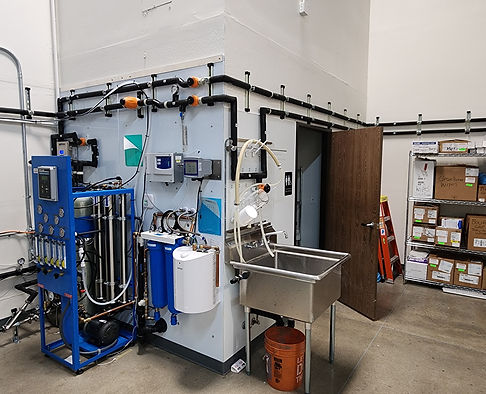

This chilled high‑purity water system was designed, engineered, and fully built onsite by Scott Sturis, using a custom architecture that solves one of the biggest problems in modern high‑purity water systems: heat‑driven microbial growth.
Traditional systems warm up due to pumps, UV systems, and room temperature environments, creating ideal conditions for bacteria to thrive. After 33 years in the field, Scott has seen this pattern repeat across the country — including performance qualification failures on brand‑new systems in Maryland and Irvine due to Ralstonia pickettii.
To break that cycle, Scott designed an additional 24/7 recirculation loop inside the walk‑in cooler, paired with stainless steel chilling coils and a fully insulated distribution loop. By chilling the water to a point where bacteria are “not as happy,” this system represents what Scott believes is the future of microbial control in high‑purity water.
Real‑World Field Experience Behind the Design
Scott has personally witnessed:
-
Ralstonia pickettii contamination during PQ on new systems in Maryland and Irvine CA
-
A customer in Irvine who had a 0.2 micron filter, and Scott switched them to a 0.1 micron just in time — the onsite microbiologist saw the organism appear the week before, but it has not returned since
-
Customers forced to tear out or replace sections of their distribution loops due to persistent, hard‑to‑kill contamination
-
Increasingly tougher bacterial strains entering city water supplies
-
Plumbing contractors contaminating loops during installation — often by simply washing their hands with city water and returning to work
These real‑world failures are exactly why this chilled‑loop design exists.
Why Chilling the Water Works
Bacteria thrive in warm, stagnant environments. Scott’s approach attacks the problem at the source:
-
Keep the water cold
-
Keep it moving
-
Keep the loop clean
-
Keep the system sealed from outside contamination
By integrating the chilled loop directly into the walk‑in cooler and running the recirculation loop 24/7, the system maintains a stable low temperature that dramatically reduces microbial activity — without external chillers, glycol loops, or complex retrofits.
Key System Components
This system integrates a full suite of high‑purity water technologies, each selected and configured to support low‑temperature microbial control and continuous Type 1 water production.
-
Double‑Pass Reverse Osmosis System for maximum ionic reduction
-
Neotech TOC Destruct UV for continuous organic load suppression
-
ResinTech Low‑TOC Resin, replaced annually for consistent performance
-
0.1 Micron Bacteria Filter, validated against Ralstonia pickettii
-
Mettler Toledo 6000TOCi Analyzer for real‑time TOC monitoring
-
Mettler Resistivity Sensor + M‑800 Multi‑Channel Transmitter
-
Stainless Steel coil side stream recirculation Loop
-
7.5 GPM Continuous Flow Rate on main distribution loop
Each component was installed, configured, and validated onsite by Scott Sturis, ensuring the system performs exactly as designed.
Chilled‑Loop Architecture
The chilled‑loop design is the core innovation of this system — a solution engineered specifically to combat the microbial challenges Scott has seen across the country.
How the Chilled Loop Works
-
The storage tank is located inside the walk‑in cooler, maintaining uniform low temperature
-
A dedicated 24/7 recirculation loop keeps water constantly moving
-
Stainless steel chilling coils sit directly in front of the air unit
-
The walk‑in cooler becomes the thermal engine, eliminating the need for external chillers
-
The entire loop is insulated and sealed to prevent heat gain and contamination
This design keeps the water cold, stable, and far less hospitable to bacteria — a major advantage over traditional ambient‑temperature systems.
Why This Matters
Scott’s field experience has shown that:
-
Warm water encourages microbial growth
-
PQ failures often trace back to temperature and stagnation
-
Tougher strains like Ralstonia pickettii are becoming more common
-
Many contamination events originate from installation & sanitization practices
-
Some facilities have been forced to tear out sections of their loop due to persistent contamination
This system was built to prevent those failures before they happen.